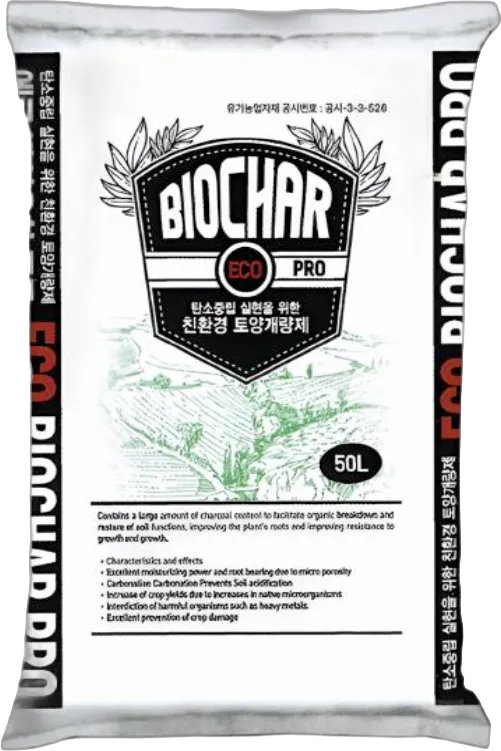
Soil amendment · powder
EcoPlus Biochar
ECO PLUS BIOCHAR
An eco-friendly soil amendment for carbon neutrality
Business · Biochar
Biochar soil amendment made from wood-pellet combustion residue. Supplied as an official distributor.
What is biochar
Biochar is a material with a porous structure produced by pyrolyzing biomass at high temperature with limited oxygen. It has excellent carbon sequestration and adsorption capacity and is an eco-friendly material that can realize carbon neutrality. In agriculture it is used for soil improvement, and in livestock farming as bedding.
Plant biomass
Dead trees · agricultural by-products
High-heat, low-oxygen pyrolysis
Limited oxygen
Biochar
Carbon sequestration · adsorption
Porous structure
Microbial habitat · water retention
Effects
Livestock and pets receive microbes; biochar gives microbes a place to live.
Soil improvement
Soil microbial activity
1.5–3×
The large surface area and micropores provide a suitable habitat for microbes that favor small spaces. In soil treated with biochar, microbial activity is 1.5–3 times that of ordinary soil, owing to greater nutrient availability, a pH suited to microbial activity (neutral to slightly acidic), adsorption of toxic substances (pesticides, heavy metals) and improved aeration.
pH adjustment
pH 8–10
Biochar is alkaline, around pH 8–10, so it neutralizes pH in acidic soil, helping crops grow in a more appropriate pH environment.
Cation exchange capacity (CEC)
NH₄⁺ · K⁺ · Ca²⁺ · Mg²⁺ · Fe²⁺ · Zn²⁺ · Cu²⁺
Biochar has a high cation exchange capacity, making it easy for soil to exchange and use nutrients such as ammonium nitrogen (NH4+), potassium (K+), calcium (Ca2+), magnesium (Mg2+), iron (Fe2+), zinc (Zn2+) and copper (Cu2+).
Better use of nutrients and water
Porous structure
Biochar's fine pores absorb and hold water like a sponge, improving the soil's water retention so crops grow better even in dry conditions. Biochar also helps nutrients stay in the soil longer instead of being lost, prolonging the effect of fertilizer and reducing the amount needed.
High-temperature biochar
EcoPlus Biochar has the characteristics of high-temperature biochar: compared with low-temperature biochar and charcoal, it shows the highest porosity and soil-improvement effect, excellent carbon sequestration, and excellent water and nutrient retention.
| Low-temp. biochar | High-temp. biochar | Charcoal | |
|---|---|---|---|
| Production temperature | 300–400℃ | 650–800℃ | 1000℃ or above |
| pH | 6–8 | 8–10 | 10–12 |
| Organic matter | 65–70% | 20–30% | 10–20% |
| Carbonization | 30–35% | 70–80% | 90% or above |
| Porosity | Low | High | High |
| Water/nutrient retention | Medium | High | Medium |
「Without high-temperature biochar, the soil-improvement effect is very low.」 — Biochar product introduction
UNICORN's technology
UNICORN has filed a patent application for a method of manufacturing a soil amendment using biochar.
Products
Choose a product here and go to its page. Application-rate calculators are on each product page.
Soil amendment · powder
ECO PLUS BIOCHAR
An eco-friendly soil amendment for carbon neutrality
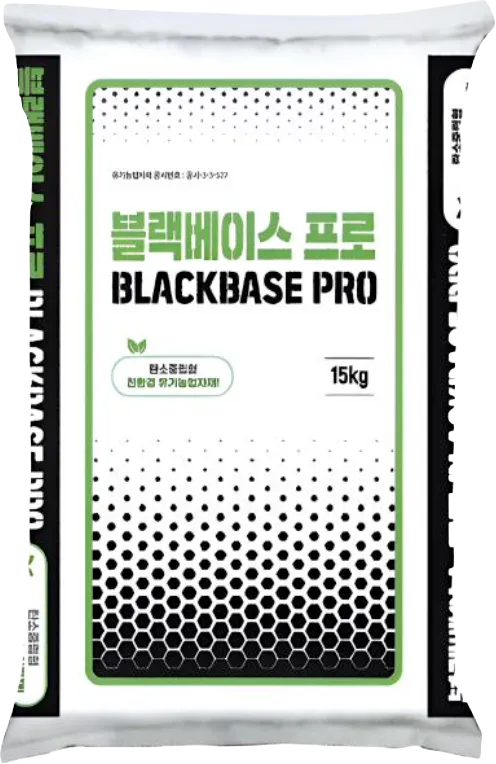
Soil amendment · pellet
Black Base Pro
Carbon-neutral eco-friendly organic farming material
| EcoPlus Biochar | BLACKBASE PRO | |
|---|---|---|
| Form | Powder | Pellet |
| Size | 50 L (10–12 kg) | 15 kg |
| Composition | 100% biochar | 20% biochar + 60% organic matter + 6% NPK |
| Character | Pure soil amendment | Soil amendment + organic fertilizer |
| Listing No. | 3-3-291 | 3-3-527 |
Prior research
All of these studies were demonstrations based on high-temperature biochar (650℃ or above).
※ Study conducted on a salt-accumulated greenhouse with very low pH / 180 kg/10a is appropriate for greenhouse cultivation at pH 6
| EC (dS/m) | pH (1:5) | CEC (cmol/kg) | |
|---|---|---|---|
| Spring | 5.2→3.7 | 6.2→6.5 | 8.8→9.4 |
| Autumn | 7.5→0.9 | 6.1→7.4 | 9.5→9.8 |
Soil physical properties
| Porosity (%) | Soil hardness (mm) | Moisture (%) | |
|---|---|---|---|
| Control | 49.1 | 18.2 | 8.3 |
| Biochar | 51.3 | 16 | 13.2 |
| Porosity (%) | Soil hardness (mm) | Moisture (%) | |
|---|---|---|---|
| Control | 48.6 | 16.8 | 10.8 |
| Biochar | 51.5 | 14.5 | 13.9 |
| EC (dS/m) | pH (1:5) | CEC (cmol/kg) | |
|---|---|---|---|
| Spring | 3.7→0.8 | 6.4→7.6 | 8.8→8.6 |
| Autumn | 4.6→0.6 | 6.6→7.1 | 8.2→8.1 |
Soil physical properties
| Porosity (%) | Soil hardness (mm) | Moisture (%) | |
|---|---|---|---|
| Control | 53.4 | 13.6 | 13.1 |
| Biochar | 54.0 | 10.3 | 16.4 |
| Porosity (%) | Soil hardness (mm) | Moisture (%) | |
|---|---|---|---|
| Control | 56.1 | 17.1 | 13.0 |
| Biochar | 60.5 | 13.6 | 14.1 |
Contact
For biochar products, please contact us.