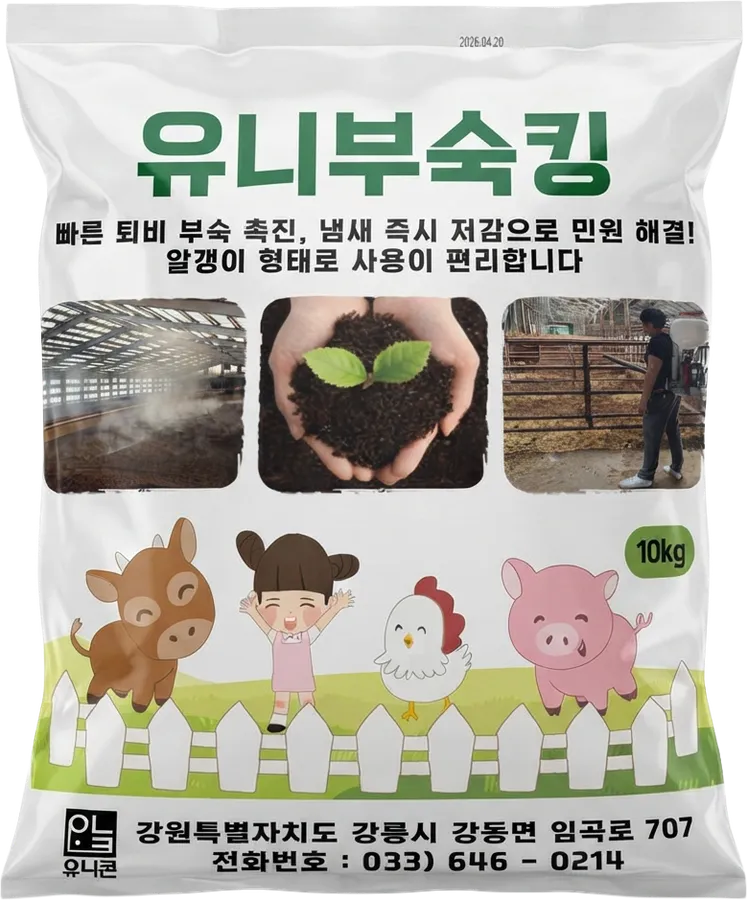
Uni Busukking
Compost Fermentation Agent
Faster composting, immediate odor reduction
Overview
Faster composting and immediate odor reduction to resolve complaints
Granular form for convenient use.
- A granular product of concentrated active microbes — contains Bacillus subtilis and Lactiplantibacillus plantarum (lactic acid bacteria)
- Contains concentrated amino acids and an odor adsorbent
Odor removal in livestock housing
- Concentrated active microbes + amino acids that help microbes multiply, in granular form
- Microbial metabolism (organic acid secretion, etc.) keeps pH low, removing odor gases such as putrid and fermentation odors, ammonia and hydrogen sulfide
Faster composting of manure in the barn
- Bacillus subtilis and lactic acid bacteria spread on manure control carbon dioxide and ammonia gas, accelerating composting
- Treated manure becomes a compost resource with fertilizer value from the metabolites left after microbes multiply and die
- The granular amino acid used as carrier has fertilizer value, helping crop farms (N-P-K: 12-3-4)
- Faster compost fermentation
- Immediate odor removal by capturing odor and gas
- High-quality compost with high value as fertilizer
Mechanism
Three mechanisms
The microbes for compost fermentation are supplied in granular form rather than simply mixed as powder. Three mechanisms — active microbes for fermentation, amino acids that feed and shelter the microbes, and an adsorbent that captures odor gases — deliver faster composting and odor removal.
Active microbes
Concentrated active microbes for fermentation
Amino acids
Food and shelter for the microbes
Adsorbent
Captures odor gases
Typical composting products simply mix carrier and microbes, so microbes cultured on a specific medium struggle to adapt and become active in the extreme new environment of a barn, and rarely gain the dominance needed to drive fermentation. Uni Busukking is designed with concentrated amino acids granulated together as microbial feed, providing food and shelter and an adaptation period, so microbes adapt easily to the new environment, fermentation speeds up, and compost is produced quickly and safely.
Technical basis
Technology transferred from the Korea Agriculture Technology Promotion Agency — mixed microbial preparation for reducing ammonia odor, and its manufacturing method (Reg. No. 10-1854277)
Comparison by form
How farms handle each form
| Form | Handling | Ease |
|---|---|---|
| Uni Busukking (granular) | Easy to handle as granules | High |
| Pellet | Easy to handle as pellets | High–medium |
| Powder | Avoided because it blows away | Low |
| Liquid | Avoided because it must be mixed with water and sprayed | Low |
“Ease” is read from bar heights in the source chart.
Microbial activity by form — Bacillus subtilis, lactic acid bacteria
| Form | Inoculated | After forming |
|---|---|---|
| Uni Busukking (granular) | 2 × 10⁸ CFU/g | 1 × 10⁸ CFU/g |
| Pellet | 2 × 10⁸ CFU/g | 1 × 10⁴ CFU/g |
| Powder | 2 × 10⁸ CFU/g | 1 × 10⁷ CFU/g |
| Liquid | 2 × 10⁸ CFU/g | 1 × 10⁸ CFU/g |
- 1 × 10⁸Uni Busukking (granular)
- 1 × 10⁴Pellet
- 1 × 10⁷Powder
- 1 × 10⁸Liquid
Log scale — bar height is proportional to log₁₀ of the value. Axis ticks: 10⁴ · 10⁵ · 10⁶ · 10⁷ · 10⁸. · CFU/g
Pellet forming generates high heat and pressure, giving a low inoculation rate. After inoculating at 10⁸, pellet forming kills most microbes down to 10³–10⁴. (Company's own review)
Microbial activity (establishment) by form
- Uni Busukking (granular)
- No high heat or pressure during forming, so 10⁸ microbes are inoculated intact (guaranteed 10⁷; shelf life 1 year). With amino acids as the base feeding the microbes, survival stays high even in long storage. Microbes settled on amino acids act as a buffer in the new environment when spread on the barn floor, giving high propagation (adaptability)
- Pellet
- High heat and pressure during pellet forming give a low inoculation rate (company's own review); after inoculating at 10⁸, pellet forming kills most microbes down to 10³–10⁴. Inoculation after forming is possible, but the coated pellet surface makes it hard for microbes to settle
- Powder
- Carrier and microbes are separated as powder, so activity is low.
- Liquid
- Microbial activity is high as a liquid, but handling is difficult (risk of spoilage in humid summer)
Deodorization test
Korea Conformity Laboratories (KCL) deodorization test — effective against ammonia, trimethylamine and hydrogen sulfide · not effective against methyl mercaptan
Directions
Directions
| Use | Amount |
|---|---|
| Barn floor | 1 bag (10 kg) per 100 pyeong, per month |
| Manure pile | 5 kg per ton, mixed in |
- Barn floor: immediate odor reduction after spreading. 4 m × 8 m barn: 10 stalls; 5 m × 10 m barn: 6 stalls.
- Manure pile: clean the barn floor and form a manure pile. Within 3–4 weeks the pile heats up, steams and shows white mold.
- Size
- 10 kg per bag (5 kg · 10 kg on KONEPS)
- Form
- Granular
- Procurement item ID
- 25287164
Calculator
Estimate how much you need
The recommended rate scaled to your input. Actual amounts may vary with feeding conditions.
Labeling
Labeling under the Feed Management Act
Reproduced as written on the product.
- Feed Registration No.
- VVM940001
- Name and Form of Feed
- Beneficial bacteria mixture / granular
- Guaranteed Analysis
- Lactobacillus plantarum 1.0 × 10⁷ cfu/g or more · Bacillus subtilis 1.0 × 10⁷ cfu/g or more
- Ingredients
- Beneficial bacteria mixture, amino acids
- Intended Use
- Feed ingredient or for livestock farms
- Precautions
- Avoid direct sunlight; store in a cool, dry, dark place
- Net Weight
- 10 kg
- Date of manufacture
- Marked separately
- Shelf life
- 12 months from date of manufacture
- Manufacturer, address, phone
- UNICORN Co., Ltd., 707, Imgok-ro, Gangdong-myeon, Gangneung-si, Gangwon-do, 25629, Rep. of KOREA, 033) 646-0214
- Repackaging
- Not applicable
- Veterinary Drugs Added
- Not applicable
- Other
- Not applicable
Purchase
Where to buy
Uni Busukking
KONEPS is a public procurement channel. For general or bulk purchases, please contact us.