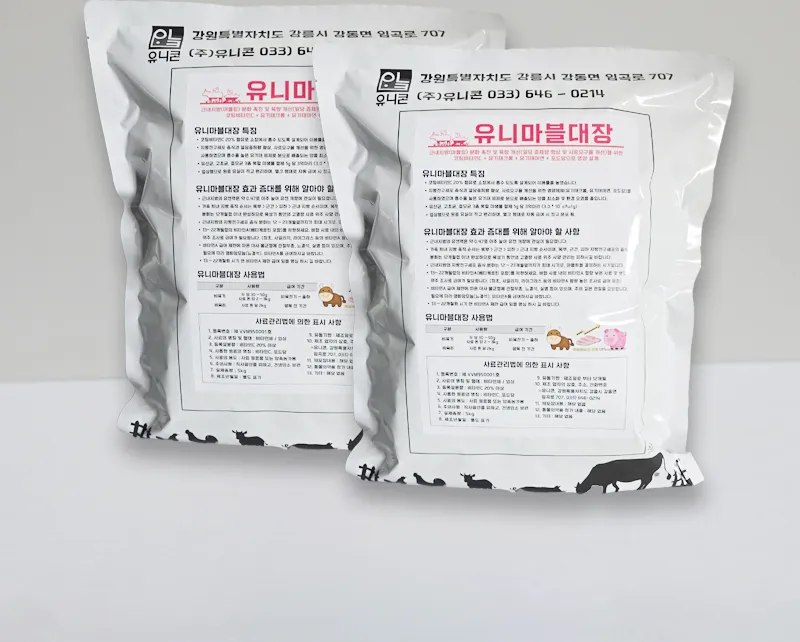
Overview
A finishing solution that improves meat quality and yield together
A product focused on raising farm income through scientific design solely for promoting intramuscular fat (marbling) differentiation and improving yield (daily weight gain, feed conversion).
- 62%Glucose
- 15%Coated vitamin C
- 12.5%Sodium bicarbonate
- 4.5%Organic zinc
- 3%Organic chromium
- 3%Three-strain complex microbes
Hanwoo growth characteristics
What marbling is
- Up to 12 months of age, growth is mainly in muscle, digestive organs, viscera and bone.
- Fat deposition occurs from 12 to 23 months, peaking at 18 months of age.
| Item | Peak growth (months) | Growth start | Growth end | Duration | Monthly increase |
|---|---|---|---|---|---|
| Live weight | 12.3 | 4.5 | 20.7 | 16.7 | 23.44 |
| Carcass | 12.8 | 5.0 | 20.7 | 15.7 | 7.19 |
| Lean meat | 10.8 | 2.7 | 18.0 | 15.3 | 3.84 |
| Fat | 17.9 | 12.4 | 23.4 | 11.0 | 3.85 |
| Bone | 5.1 | −0.6 | 10.7 | 11.3 | 0.88 |
| Visceral organs | 6.4 | 1.6 | 11.2 | 9.6 | 2.18 |
| Visceral fat | 16.0 | 11.4 | 20.6 | 9.2 | 3.82 |
| Stomach | 6.2 | 0.6 | 11.9 | 11.3 | 0.59 |
| Intestine | 3.4 | −5.1 | 11.8 | 10.9 | 0.24 |
| Other | 8.1 | 2.2 | 18.2 | 16.0 | 2.47 |
Peak growth, growth start and end: months of age / Duration: months / “Monthly increase”: no unit given in the source
Marbling is the increase in intramuscular fat cells in the perimysium between muscle fibers, meaning an increase in the number of differentiated preadipocytes.
- 1More differentiated preadipocytes
- 2More intramuscular fat cells
- 3Better marbling
Not the enlargement of mature fat cells
Order of fat deposition
Intramuscular fat comes last
- Order of fat deposition: abdominal > intermuscular > subcutaneous > intramuscular fat.
- Intramuscular fat related to marbling increases rapidly during finishing, and its share is relatively small compared with other fat.
Fat deposition by site
Intramuscular fat (marbling) is last in the order of deposition, and its amount is very small compared with other fat.
Subcutaneous vs. intramuscular fat deposition — feeding mainly high-energy feed during the growing period affects subcutaneous fat (backfat thickness), raising the likelihood of a C grade.
| Form of deposition | Completion | Effect on carcass | |
|---|---|---|---|
| Subcutaneous fat | Increase in fat cell size (volume) | Proliferation and differentiation of kidney and subcutaneous fat complete within 12 months, then maturation | Backfat thickness |
| Intramuscular fat | Increase in the number of fat cells | Differentiation from 12 to 23 months of age, followed by maturation | Marbling score |
Advanced feeding technology is required. Only Uni Marble Daejang, based on scientific design, makes it possible.
Vitamin A control technology
The substance that suppresses fat deposition
- A fat-soluble vitamin stored in the liver and fat tissue, absorbed mainly in the small intestine.
- Involved in vision, antioxidant action, reproduction and mucosal cell differentiation, but with the critical drawback of suppressing fat deposition.
- Beta-carotene (β-carotene, 1 IU = 0.6 ㎍) is the precursor of vitamin A.
- Vitamin A activity unit: 1 IU = 0.0000003 g = 0.3 ㎍
| Metabolite | Action in the body |
|---|---|
| Retinal | Normal vision |
| Retinol | Antioxidant action |
| Retinoic acid | Normal growth and development, reproduction, mucosal cell differentiation, suppression of fat deposition |
| Blood level | Vitamin A restriction period | |
|---|---|---|
| Typical vitamin A level in finishing cattle | 300 ㎍ / L (100 IU) | − |
| Restricted vitamin A level in finishing cattle | 90 ㎍ / L (30 IU) | 12–23 months of age (about 10 months) |
- 1Vitamin A
- 2Beta-carotene
- 3Suppresses fat cell differentiation
- 1Vitamin A restriction in late finishing
- 2Induces intramuscular fat deposition
If vitamin A suppresses (intramuscular) fat deposition, there are also substances that activate it. Uni Marble Daejang is a dedicated product for meat quality and yield.
Technical basis
Technology transferred from the Korea Agriculture Technology Promotion Agency — livestock feed additive for improving meat quality, and its manufacturing method (Reg. No. 10-1352375)
Main nutrients and ingredients
How the six ingredients work
Coated vitamin C 15%
- Better marbling
- Increases the activity of fat-synthesizing enzymes, promoting the differentiation of preadipocytes into fat cells. Deficiency suppresses preadipocyte differentiation.
- Strong antioxidant, better immunity
- Vitamin C acts as an antioxidant in the body. Meat discolors from bright red to brown over time, oxidizing and producing odor (myoglobin → metmyoglobin). By preventing oxidation of the fat in meat, vitamin C delays discoloration and keeps meat fresh.
- Anti-scurvy factor, prevents muscle hemorrhage
- Helps synthesize the collagen protein that builds strong skin, blood vessels, tendons and ligaments. Collagen synthesis is important for vessel strength; it requires hydroxyproline and hydroxylysine, and vitamin C is needed for the enzyme that adds OH groups to proline/lysine.
- Coating
- Vitamin C is effective only when absorbed in the small intestine. When fed to cattle it is broken down by rumen enzymes and microbes, leaving little effect. Coated vitamin C overcomes this and is designed to be absorbed in the small intestine.
Organic chromium (Cr³⁺) 3%
- GTF, glucose tolerance factor
- Plays a decisive role in activating and increasing insulin receptors in cells and peripheral tissue, and facilitates the binding of insulin to fat cell membranes.
- Effect on carbohydrate metabolism
- Improves glucose absorption and the efficiency of fat synthesis from glucose. Deficiency reduces glucose tolerance and impairs glucose energy use, causing diabetes and hyperglycemia.
- Effect on fat metabolism
- Maintains serum cholesterol homeostasis and increases HDL (high-density lipoprotein).
- Effect on protein metabolism
- Insulin is needed for amino acid metabolism in protein synthesis, and chromium acts as a cofactor.
- Higher ovulation rate
- GnRH release from the hypothalamus causes the anterior pituitary to secrete LH; insulin increases LH frequency and Cr raises sensitivity.
- Other
- Stronger immunity, less stress, better weight gain and feed efficiency
Glucose 62%
- Favors marbling
- As the carbon source for intramuscular fat synthesis, glucose is highly available, favoring marbling formation
- Favors thin backfat
- Glucose is poorly available for subcutaneous fat synthesis, favoring thin backfat
Organic zinc (Zn) 4.5%
- Action in the body
- An essential component of enzymes in protein and carbohydrate metabolism, with an important role in immune and other defense systems. Increases muscle mass and promotes intramuscular fat deposition. Prevents diarrhea, improves daily gain, feed efficiency and immune function. Reduces somatic cell count, prevents mastitis and foot rot, increases milk yield, improves laying and hatching rates
- Deficiency
- Delayed growth, reduced feed intake and efficiency, lethargy, delayed testicular growth, keratinization of legs, head, neck and nose.
Sodium bicarbonate 12.5%
- Rumen acidity
- As ruminants, Hanwoo need the rumen kept neutral (pH 6.8–7.0) for healthy production. When large amounts of concentrate are fed during finishing, rumen acidity turns acidic (pH 4.5–5.5), causing rumen acidosis and other digestive diseases.
- Chemical buffer
- Sodium bicarbonate (NaHCO3) has both acidic and basic properties, but most importantly acts as a chemical buffer. The buffer formed when it reacts with water in the rumen prevents pH changes.
Three-strain complex microbes 3%
- Action
- Better feed efficiency by suppressing harmful bacteria and increasing beneficial microbes / better digestibility, prevention and reduction of digestive and metabolic diseases / less odor and a better livestock environment through reduced harmful gas / higher dry-matter intake and milk yield through rumen activation
- Composition
- Lactiplantibacillus plantarum (lactic acid bacteria) · Bacillus subtilis · Saccharomyces cerevisiae (yeast), 1.0 × 10⁸ cfu/g each
Composition
Composition table
| Ingredient | Ratio | Content |
|---|---|---|
| Coated vitamin C | 15% | 150 g per kg |
| Organic zinc | 4.5% | 45 g per kg |
| Organic chromium | 3% | 30 g per kg |
| Glucose | 62% | 620 g per kg |
| Lactic acid bacteria | 1% | 1.0 × 10⁸ cfu/g |
| Bacillus subtilis | 1% | 1.0 × 10⁸ cfu/g |
| Yeast | 1% | 1.0 × 10⁸ cfu/g |
| Sodium bicarbonate | 12.5% | 125 g per kg |
Directions
Directions
| Type | Amount | Period |
|---|---|---|
| Steer finishing | 30–50 g per head per day · 3–5 kg per ton of feed | 13 months to shipment (feed at least 10 months before shipment) |
| Cow finishing | 50 g per head per day | 10 months before shipment |
- Size
- 5 kg (box of 20 kg: 5 kg × 4)
- Form
- Granular
Calculator
Estimate how much you need
The recommended rate scaled to your input. Actual amounts may vary with feeding conditions.
Labeling
Labeling under the Feed Management Act
Reproduced as written on the product.
- Feed Registration No.
- VVM950001
- Name and Form of Feed
- Vitamin preparation, granular
- Guaranteed Analysis
- Vitamin C 15% or more
- Ingredients
- Vitamin C, glucose
- Intended Use
- Feed ingredient or for livestock farms
- Precautions
- Avoid direct sunlight; store in a cool, dry, dark place
- Net Weight
- 5 kg (box of 20 kg: 5 kg x 4)
- Use-by Date
- 12 months from date of manufacture
- Manufacturer
- UNICORN Co., Ltd.
- Address, phone
- 707, Imgok-ro, Gangdong-myeon, Gangneung-si, Gangwon-do, 25629, Rep. of KOREA, 033) 646-0214
- Repackaging
- Not applicable
- Veterinary Drugs Added
- Not applicable
Purchase
Where to buy
Uni Marble Daejang